
The Guide
What Retirement Benefits Do Federal Employees Receive?




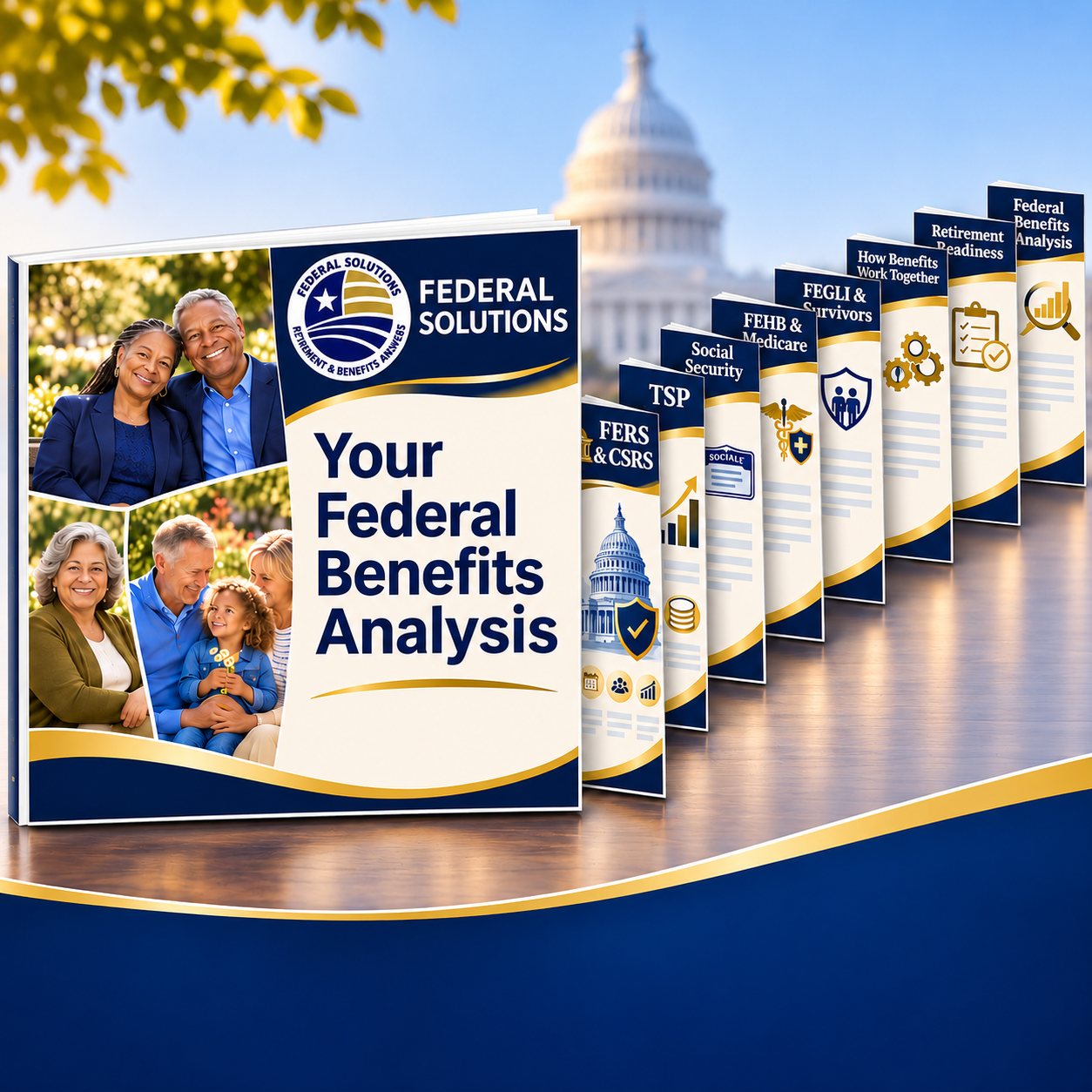
Federal employees receive a combination of pension benefits, retirement savings, Social Security, health insurance, life insurance, and survivor benefits. The benefits available depend on your retirement system, employment history, eligibility, and coverage elections.
For most employees covered by the Federal Employees Retirement System (FERS), retirement income is built around three components: a federal pension, the Thrift Savings Plan (TSP), and Social Security.
But retirement readiness involves more than income. Understanding how FEHB, FEGLI, Medicare, and survivor benefits fit into your retirement is equally important.
At Federal Solutions, we believe your best decision is an informed decision. Our Federal Benefits Experts help you see the complete picture.
1. How Do Federal Retirement Benefits Work Together?
Understanding Your Benefits Is Important. Understanding How They Work Together Changes Everything.
Federal employees have access to a valuable combination of retirement and insurance benefits.
But knowing what each benefit provides is only part of preparing for retirement.
The real opportunity comes from understanding how your benefits interact, and how decisions about one benefit can influence the value, timing, and effectiveness of the others.
Your FERS or CSRS pension, Thrift Savings Plan (TSP), Social Security, FEHB, Medicare, FEGLI, and survivor benefits are not isolated pieces of your retirement. Together, they help determine your retirement income, healthcare costs, financial flexibility, and protection for your family.
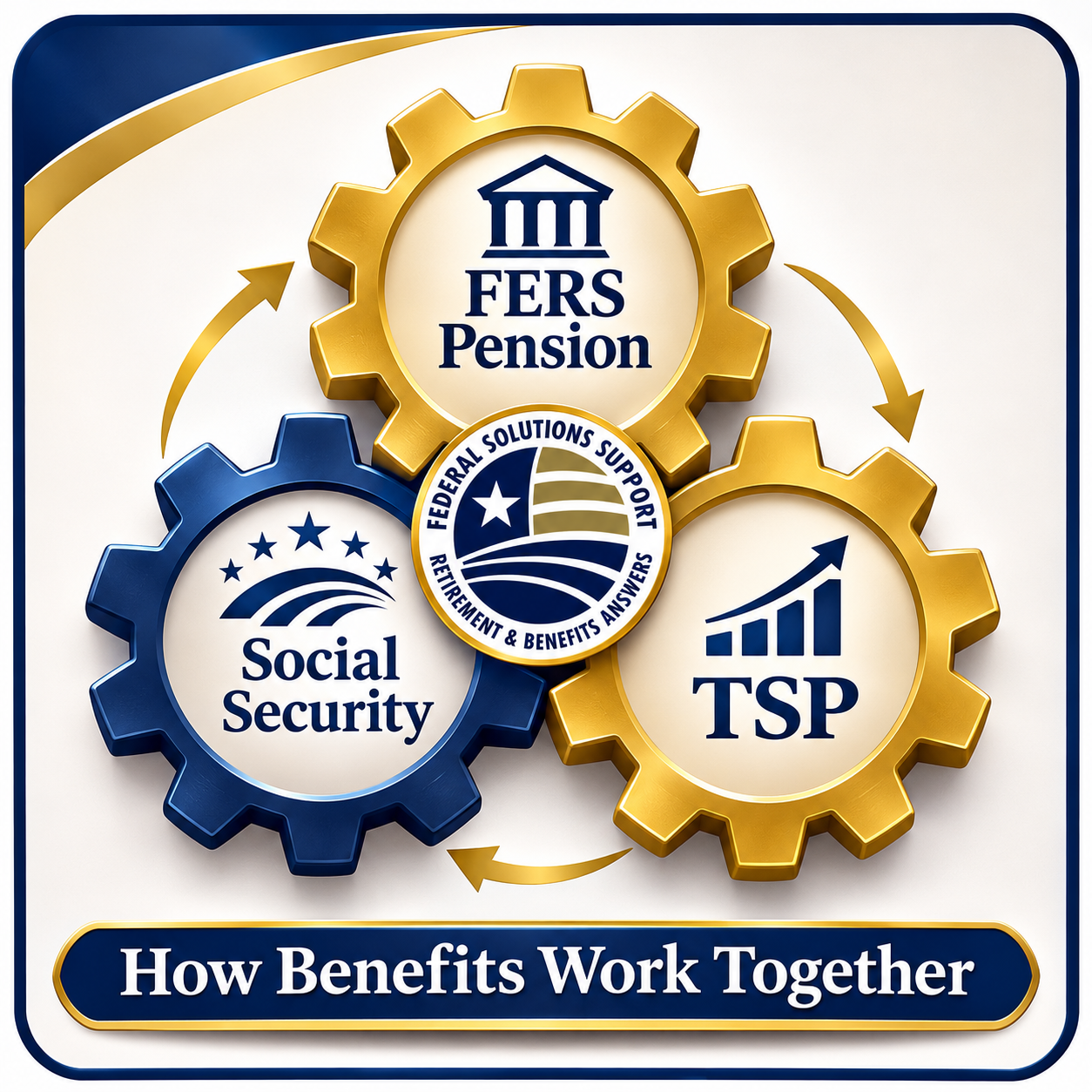
Federal retirement decisions rarely happen in isolation.
Consider how a single decision—such as choosing your retirement date—can influence multiple parts of your financial future.Your Retirement Date
Retiring earlier or later may affect your pension calculation, eligibility for certain retirement benefits, the timing of your Social Security benefits, and how soon you need to begin drawing from your TSP.Your Social Security Claiming Decision
Beginning Social Security early may provide income sooner but reduce your monthly benefit compared with waiting. Delaying benefits may increase future monthly income but require additional withdrawals from TSP or other resources in the meantime.Your TSP Withdrawal Strategy
How much you withdraw, when you withdraw it, and which accounts you use can affect your taxes, investment longevity, and ability to respond to unexpected expenses or market downturns.Your Healthcare Decisions
FEHB and Medicare enrollment decisions affect premiums, out-of-pocket healthcare expenses, and the amount of retirement income available for other priorities.Your Survivor Benefit Elections
Choosing survivor pension benefits may reduce your own monthly pension while providing continuing income for an eligible spouse. These elections can also be important to maintaining a surviving spouse's FEHB coverage. The result is a series of interconnected decisions; not simply a collection of individual benefit choices.
Understanding Your Retirement Income Gap
One of the most valuable exercises in retirement planning is identifying the difference between your expected retirement income and the amount you anticipate needing. Your pension and Social Security may cover a portion of your monthly expenses. Your TSP may need to provide the difference. But that income gap may change over time. For example:
You may retire before becoming eligible to collect Social Security.
Certain temporary retirement supplements may end at a specified age.
Healthcare premiums and other living expenses may increase.
TSP withdrawals may need to change as market conditions and financial needs evolve.
Required minimum distributions may affect withdrawals and taxes later in retirement.
Identifying Gaps, Overlaps, and Missed Opportunities
A comprehensive review of federal retirement benefits can help reveal important issues that may not be obvious when benefits are considered individually.
Potential gaps: Will your expected income cover your expenses? Is your spouse adequately protected? Have you accounted for healthcare costs and inflation?
Potential overlaps: Are you paying for insurance coverage that duplicates other protection? Could your FEHB and Medicare choices be coordinated more effectively?
Potential opportunities: Would a different retirement date improve your benefits? Could adjusting the timing of Social Security or TSP withdrawals better support your income needs? Have you received credit for all eligible federal and military service?
These are not simply questions about how much you have accumulated. They are questions about how effectively your benefits can support your retirement.
Social Security: Provides another source of retirement income, with claiming decisions that can significantly affect the monthly benefit you receive.
Thrift Savings Plan (TSP): Provides retirement savings that can supplement your pension and Social Security, offering flexibility in how and when you access your money.
Each component serves a different purpose. Your pension and Social Security may provide predictable monthly income, while your TSP can help cover additional expenses, bridge income gaps, or provide financial flexibility throughout retirement.
But the real question is whether these three sources will work together to provide the income you need—when you need it.
One Decision Can Affect Several Benefits
Three Sources of Retirement Income. One Coordinated Strategy.
For most FERS employees, retirement income is built around three primary components:
FERS Pension: Provides recurring retirement income based on your creditable service, high-three average salary, and applicable retirement formula.
Questions to Ask Your Federal Benefits Expert | Bringing Your Benefits Together
How much retirement income can I realistically expect?
What will my FERS or CSRS pension, Social Security, and TSP provide together?Will I have an income gap in retirement?
If so, how much will I need to withdraw from my TSP or other savings to maintain my desired lifestyle?What is the most advantageous retirement date for my circumstances?
How would retiring earlier or later affect my pension, insurance eligibility, and other benefits?How should I coordinate my Social Security and TSP withdrawals?
What are the potential effects on my taxes, income, and long-term savings?Am I overlooking gaps or paying for overlapping benefits?
Are my FEHB, Medicare, FEGLI, and survivor benefit elections working together effectively?How would a market downturn or unexpected expense affect my retirement?
Do I have sufficient flexibility to protect my income and savings?What happens to my spouse's financial security if I pass away first?
How will survivor pension benefits, Social Security, TSP, life insurance, and healthcare coverage work together?What does my complete federal retirement picture look like?
Am I making decisions based on an integrated analysis or evaluating each benefit separately?
Are You Sure Your Benefits Are Working Together for You?
You may know the estimated value of your FERS pension, the balance in your Thrift Savings Plan (TSP), and what you expect to receive from Social Security. But knowing those numbers individually doesn't necessarily tell you what your retirement will actually look like, or whether your benefits are working together to support the future you envision.
Every retirement decision has the potential to influence another.
The date you retire can affect your pension income.
The timing of Social Security can change your long-term income strategy.
Healthcare costs, survivor benefit elections, taxes, and TSP withdrawal decisions can all influence how much income you have available, and how long your retirement savings may need to last.
That's why looking at your federal benefits one at a time can leave important questions unanswered. At Federal Solutions, we believe your retirement deserves more than a collection of estimates. Our comprehensive Federal Benefits Analysis brings your benefits into one integrated picture, helping you understand how they interact, identify potential gaps, and recognize opportunities that might otherwise go unnoticed.
Your federal benefits represent years (often decades) of dedicated public service. You've worked hard to earn them. Now it's time to understand how to make informed decisions about using them to support the retirement you've worked toward.
Because the most important question isn't simply what each benefit is worth. It's how well they work together for you.
Official reference: Office of Personnel Management — This official publication specifically explains the three components of FERS and how they work together. See page 2.
2. FERS and CSRS | Your Federal Pension
What is FERS?
The Federal Employees Retirement System provides eligible federal employees with a defined-benefit pension, Social Security coverage, and access to the Thrift Savings Plan.
Your FERS portion of your retirement generally depends on your years of creditable service, your highest three consecutive years of basic pay, and the applicable pension calculation.
What is CSRS?
The Civil Service Retirement System (CSRS) was established in 1920 and generally covers federal employees who began their federal service before January 1, 1984. The Federal Employees Retirement System (FERS) replaced CSRS for most new federal employees beginning January 1, 1987.
CSRS provides a defined-benefit pension calculated using years of creditable service and high-three average salary. Unlike FERS, CSRS generally does not include Social Security coverage for federal employment, although employees may qualify for Social Security through other covered employment.
Important distinction: Employees hired between 1984 and 1986 were generally placed under interim retirement arrangements before FERS took effect in 1987. Some employees also have combined CSRS and FERS service under CSRS Offset or transfer provisions.
Questions to Ask Your Federal Benefits Expert | Understand Your FERS
Retirement Eligibility: When can I retire, and which retirement options are available to me?
Pension Income: What will my estimated monthly FERS or CSRS pension be?
Retirement Timing: How would retiring earlier—or working a few more years—affect my pension and other benefits
Creditable Service: Have all my eligible years of federal and military service been properly credited toward retirement?
Official reference: Office of Personnel Management — FERS retirement eligibility and pension calculation.
3. Thrift Savings Plan (TSP) | Making Your Savings Work in Retirement
The Thrift Savings Plan (TSP) is a retirement savings and investment program for federal employees and members of the uniformed services. For many federal employees, it represents one of their largest retirement assets.
While your FERS pension and Social Security may provide a foundation of retirement income, your TSP.gov can help bridge the gap between guaranteed income and the lifestyle you envision.
But accumulating savings is only half the equation. How you manage, protect, and withdraw your TSP savings can significantly influence your financial security throughout retirement.
As retirement approaches, important considerations include your investment allocation, exposure to market volatility, withdrawal timing, tax implications, and the risk of outliving your savings.
Understand how your TSP works alongside your FERS pension and Social Security is essential to creating an integrated and wholistic retirement income strategy.
Questions to Ask Your Federal Benefits Expert | Understand Your TSP
How much income will I need from my TSP each month to supplement my FERS pension and Social Security?
Is my current TSP investment allocation appropriate for my retirement timeline and income needs?
What happens if the market declines just before or after I retire? How could that affect my savings and withdrawal strategy?
How should I structure my TSP withdrawals to provide income while helping my savings last throughout retirement?
What are the tax implications of withdrawing from traditional versus Roth TSP accounts?
Should I keep my savings in the TSP or evaluate other retirement options? What are the advantages, costs, limitations, and trade-offs?
How will my TSP decisions affect my spouse or beneficiaries and the financial security I hope to leave behind?
Explore Your TSP Options
Your TSP decisions should not be made in isolation. Learn how your investment choices, withdrawal options, and retirement timeline can work together to support your long-term financial goals.
Official reference: Thrift Savings Plan — invest your way.
4. Social Security | Making the Most of Your Retirement Benefits
For federal employees covered by the Federal Employees Retirement System (FERS), Social Security is an important part of retirement income. Together, your FERS pension, Thrift Savings Plan (TSP), and Social Security can provide three complementary sources of financial support throughout retirement.
But knowing how much Social Security you may receive is only the beginning. When you claim your benefits (and how you coordinate them with your other retirement income) can make a meaningful difference in your long-term financial security.
You can generally begin collecting Social Security retirement benefits as early as age 62, but claiming before your full retirement age permanently reduces your monthly benefit. Waiting beyond full retirement age can increase your monthly benefit through delayed retirement credits, up to age 70.
For married couples, the decision becomes even more important. Your claiming strategy may affect not only your own retirement income but also the benefits available to your spouse or surviving spouse.
Federal employees should also consider several additional factors:
Retirement timing: You may retire from federal service before you begin collecting Social Security. Understanding how to bridge that income gap is important.
Taxes and other income: Your pension, TSP withdrawals, and other taxable income may affect how much of your Social Security benefit is subject to federal income tax.
Working in retirement: If you claim Social Security before full retirement age and continue working, the earnings test may temporarily reduce your benefits.
CSRS and mixed service: Employees with CSRS, CSRS Offset, or other mixed employment histories should understand how their federal service and Social Security-covered earnings affect their eligibility and benefit calculations. The Social Security Fairness Act repealed the Windfall Elimination Provision (WEP) and Government Pension Offset (GPO) for benefits payable beginning January 2024.

Questions to Ask Your Federal Benefits Expert | Understanding Your Social Security
When should I begin collecting Social Security? How would claiming at age 62, full retirement age, or age 70 affect my monthly income?
How much Social Security income can I expect? Are my earnings history and estimated benefits accurate?
How should I coordinate Social Security with my FERS pension and TSP? Which income sources should I use first, and why?
What happens if I retire from federal service before claiming Social Security? How will I replace that income in the meantime?
How could my claiming decision affect my spouse? What spousal and survivor benefits should we consider?
Will my pension, TSP withdrawals, or continued employment affect my Social Security benefits or taxes?
Could my federal service history affect my Social Security calculation? What should I know if I have CSRS, CSRS Offset, or a combination of federal and private-sector employment?
Understand Your Social Security Options
Social Security is more than a monthly benefit. It is an important component of your overall retirement income strategy. Understanding your claiming options, coordinating benefits with your spouse, and evaluating how Social Security works alongside your federal pension and TSP can help you make more informed decisions.
Use our Free Social Security Calculator. Official Source: Social Security Administration — Retirement Benefits
5. FEHB and Medicare | Protecting Your Healthcare in Retirement
Healthcare is one of the most important considerations in federal retirement planning. Eligible federal employees may continue coverage through the Federal Employees Health Benefits (FEHB) Program, while eligible Postal Service employees and retirees are covered through the separate Postal Service Health Benefits (PSHB) Program. Military-connected federal retirees may also have TRICARE options, depending on their eligibility. Understanding how these programs interact with Medicare is essential when evaluating healthcare coverage and costs in retirement.
Unlike many private-sector employees who lose employer-sponsored health insurance when they retire, eligible federal retirees can generally continue their FEHB coverage, helping provide continuity of healthcare for themselves and their covered family members.
However, keeping your FEHB coverage in retirement is not automatic. Understanding the eligibility requirements before you retire is essential.
Keeping Your FEHB Coverage After Retirement
To continue FEHB into retirement, federal employees generally must retire on an eligible immediate annuity and have been enrolled in FEHB for the five years immediately preceding retirement; or for the entire period since their first opportunity to enroll, if less than five years. Certain exceptions, waivers, and special retirement circumstances may apply.
Once retired, eligible individuals can generally retain FEHB coverage, with premiums deducted from their FERS (federal retirement annuity). The government ordinarily continues contributing toward the cost of coverage.
How Medicare Changes the Equation
As you approach age 65, another important decision arises: How should Medicare and FEHB work together?
Medicare and FEHB can complement one another, but the right combination depends on your healthcare needs, financial circumstances, and the specific FEHB plan you carry.
Important considerations include:
Medicare Part A: Many federal retirees qualify for premium-free hospital coverage through Medicare.
Medicare Part B: Provides outpatient and physician coverage, generally requires a monthly premium, and may reduce certain out-of-pocket expenses when coordinated with FEHB.
Coordination of benefits: Understanding which program pays first can help you anticipate healthcare costs and avoid unnecessary expenses.
Enrollment timing: Delaying Medicare Part B can result in late-enrollment penalties unless you qualify for an applicable special enrollment period. FEHB coverage as a retiree generally does not provide the same Part B enrollment protections as coverage based on current employment.
Spousal coverage: Your Medicare choices and FEHB enrollment decisions may affect how you and your spouse coordinate healthcare coverage throughout retirement.
The goal is not simply to maintain insurance—it is to understand how your coverage, premiums, and potential out-of-pocket costs will work together as your healthcare needs change.
Questions to Ask Your Federal Benefits Expert | Understanding FEHB & Medicare
Can I keep my FEHB coverage when I retire? Have I satisfied the five-year enrollment requirement and other eligibility rules?
What will my FEHB coverage cost in retirement? How will premiums be deducted, and will the government's contribution continue?
Should I enroll in Medicare Part B at age 65? What are the advantages, additional costs, and potential consequences of delaying enrollment?
How will Medicare and FEHB coordinate my healthcare expenses? Which coverage pays first, and could certain FEHB plans offer additional benefits for Medicare enrollees?
Will my spouse remain covered under FEHB? What happens to their coverage if I retire, change plans, or pass away?
Should I reconsider my current FEHB plan before retirement? Could another available plan better meet our healthcare and financial needs?
What healthcare expenses should I anticipate in retirement? How should premiums, deductibles, prescriptions, and other out-of-pocket costs factor into my retirement income plan?
Make Informed Healthcare Decisions Before You Retire
Your healthcare decisions should be considered alongside your federal pension, Social Security, and TSP income. Understanding FEHB eligibility, Medicare enrollment, and the costs of maintaining coverage can help you protect both your health and your retirement finances.
Official Source: U.S. Office of Personnel Management — Federal Employees Health Benefits Program. Also checkout OPM — FEHB and Medicare — Explains how FEHB and Medicare coverage work together & OPM — Postal Service Health Benefits (PSHB) — Explains the separate health benefits program for postal employees and retirees.
6. FEGLI and Survivor Benefits| Protecting the People Who Matter Most
Your federal benefits provide more than retirement income. They can also offer important financial protections for your spouse, family, and other loved ones.
The Federal Employees' Group Life Insurance (FEGLI) Program provides eligible federal employees with life insurance coverage, while federal retirement survivor benefits may provide continuing pension income to eligible loved ones after your death. But these protections work differently, and the decisions you make before retirement can have lasting consequences for your family's financial security.
Understanding Your FEGLI Coverage in Retirement
FEGLI offers several types of coverage, including Basic Life Insurance and optional coverage under Options A, B, and C.
Eligible federal employees may continue certain FEGLI coverage into retirement, generally provided they retire on an immediate annuity and satisfy applicable enrollment requirements, including the five-year coverage rule or first-opportunity exception.
However, coverage and costs can change after retirement. Important considerations include:
Coverage elections: Retirees may have choices about how much Basic and optional coverage they retain and whether coverage reduces as they age.
Premium changes: Some FEGLI premiums increase significantly with age, particularly for optional coverage.
Coverage reductions: Certain retirement elections allow insurance coverage to decrease over time, potentially reducing premiums while also reducing the death benefit available to beneficiaries.
Beneficiary designations: Keeping your FEGLI beneficiary information current helps ensure benefits are directed according to your wishes.
Understanding what coverage you have today and what it will look like 10, 20, or 30 years into retirement—is an important part of evaluating your long-term insurance needs.
Understanding Federal Pension Survivor Benefits
Life insurance is only one part of protecting your family. Under FERS and CSRS, eligible retirees may elect survivor annuity benefits that provide continuing pension income to a spouse or other qualifying survivor after the retiree's death.
These elections generally involve a trade-off: Providing a survivor annuity reduces your own retirement pension but may help protect your spouse's future income. For example, under FERS, an eligible married retiree may elect a full or partial spouse survivor annuity, subject to applicable rules and spousal consent requirements. Important considerations include:
Survivor income: How much pension income would your spouse receive if you passed away first?
Retirement income reduction: How much would your own monthly pension decrease to provide survivor protection?
Health insurance continuity: For many surviving spouses, maintaining FEHB coverage after the retiree's death depends on eligibility for a survivor annuity and applicable coverage requirements.
Other financial resources: Life insurance, Social Security survivor benefits, TSP savings, and other assets may also contribute to your family's financial security.
Election deadlines: Certain survivor benefit decisions must be made at retirement and can be difficult or impossible to change later, except under specific circumstances.
The goal is to understand how your life insurance, pension survivor benefits, healthcare coverage, and other financial resources work together to protect those you love.

Questions to Ask Your Federal Benefits Expert | Understanding FEGLI & Survivor Benefits
What happens to my FEGLI coverage when I retire? Which policies can I keep, and what coverage reductions should I anticipate?
How much will my life insurance cost throughout retirement? Could premiums increase as I age, and what alternatives should I evaluate?
How much life insurance does my family actually need? Am I carrying too much, too little, or the right amount of coverage?
What survivor pension election should I consider? How would a full or partial survivor benefit affect my monthly retirement income?
What happens to my spouse's income and FEHB coverage if I pass away first? Would my current elections provide the protection they need?
How do FEGLI, survivor pension benefits, Social Security, and TSP work together? Are there gaps or unnecessary overlaps in my family's financial protection?
Are my beneficiary designations and survivor elections up to date? Have I accounted for changes in my family or financial circumstances?
Make Your Retirement Decisions With Your Family in Mind
Your retirement plan should reflect more than your financial needs today. It should also consider the people who may depend on your benefits tomorrow. Understanding your FEGLI coverage, survivor pension options, and family protection needs can help you make informed decisions before retirement.
Official Source: U.S. Office of Personnel Management — FEGLI Program. OPM — FEGLI Handbook — Detailed information about coverage, premiums, and retirement elections. OPM — FERS Survivor Benefits — Explains survivor annuity benefits for eligible family members.
7. Am I Ready to Retire From Federal Service?
Being Eligible to Retire & Being Ready to Retire Are Two Different Things.
After years of federal service, reaching retirement eligibility is an important milestone. But qualifying for retirement doesn't necessarily mean you're financially or personally prepared to take that next step.
Retirement eligibility tells you when you can retire. Retirement readiness helps you understand whether you're prepared to retire, and what that retirement might look like.
For federal employees, retirement involves coordinating multiple benefits, making important elections, and preparing for a significant change in income and lifestyle.
The decisions you make before leaving federal service can influence your financial security for decades.
Five Important Areas of Retirement Readiness
1. Understanding Your Retirement Income
Do you know how much income you can expect from your FERS or CSRS pension, Social Security, and Thrift Savings Plan?
More importantly, do you know whether those income sources will be sufficient to support your anticipated retirement expenses?
Your retirement income may change over time as Social Security begins, temporary benefits end, or TSP withdrawals increase.
2. Preparing for Healthcare Costs
Have you confirmed your eligibility to continue FEHB coverage into retirement?
Do you understand how Medicare may affect your healthcare choices, premiums, and out-of-pocket expenses?
Healthcare decisions can have a lasting effect on your retirement budget, particularly as your needs change with age.
3. Protecting Your Spouse and Family
Have you evaluated your FEGLI coverage, survivor pension elections, and beneficiary designations?
Would your spouse have sufficient income and healthcare coverage if you passed away first?
Understanding how your family would be protected is an important part of preparing for retirement.
4. Evaluating Your TSP and Financial Risks
Is your TSP investment allocation appropriate for your retirement timeline?
Have you considered how a market downturn, inflation, unexpected expenses, or withdrawals early in retirement could affect your savings?
A retirement income strategy should account for both your anticipated needs and the unexpected challenges that may arise.
5. Envisioning Your Retirement Lifestyle
Have you thought beyond your last day of federal employment?
What will your daily life look like? Will you travel, pursue hobbies, spend more time with family, volunteer, or begin another chapter of work?
Understanding the retirement you want is essential to evaluating the income and resources you may need to support it.
Questions to Ask Your Federal Benefits Expert | Evaluating Your Retirement Readiness
Am I financially prepared to retire? Will my FERS or CSRS pension, Social Security, and TSP provide enough income to support my retirement goals?
What is the best retirement date for my circumstances? How would retiring now versus working another year or two affect my benefits and financial outlook?
What will my actual retirement income look like? How much can I expect to receive after taxes, healthcare premiums, survivor elections, and other deductions?
How long could my TSP savings last? What withdrawal strategy should I consider, and how could market volatility affect my retirement?
Have I accounted for healthcare and family protection? Are my FEHB, Medicare, FEGLI, and survivor benefit decisions aligned with my needs?
What financial risks could affect my retirement? Have I considered inflation, unexpected expenses, longevity, and changes in income?
What am I overlooking? Are there benefit elections, eligibility requirements, or planning opportunities I should address before leaving federal service?
Discover Your Federal Retirement Readiness Score
You don't need to have every retirement decision finalized to begin preparing. But understanding where you stand today can help you identify what deserves attention before you retire.
Federal Solutions offers a complimentary Federal Retirement Readiness Check™, designed to help federal employees evaluate their understanding of important retirement decisions and identify areas where additional education or analysis may be valuable.
The assessment explores key considerations involving your federal pension, TSP, Social Security, healthcare coverage, and retirement planning.
10 Questions.
About 2 Minutes.
Your Readiness Score.
Your results provide a starting point for understanding your retirement preparedness and recognizing questions worth exploring with a Federal Benefits Expert. Take the Federal Retirement Readiness Check™
Retirement Begins With a Clear Picture of Your Future
The goal isn't simply to reach retirement eligibility. It's to enter retirement understanding your benefits, your choices, and how they can support the life you envision. Get Your Readiness Score | 10 Questions | 2 Minutes. Take the Federal Retirement Readiness Check
Official Source: U.S. Office of Personnel Management — Planning and Applying for Federal Retirement & https://www.opm.gov/retirement-center/fers-information/eligibility/
8. Get the Complete Picture With a Federal Benefits Analysis
What Can a Federal Retirement Benefits Analysis Help You Understand?
Your Retirement Income
Understand your estimated FERS or CSRS pension, Social Security benefits, and potential TSP income. See how these sources may work together to support your anticipated retirement lifestyle.
Your Retirement Timing
Explore how different retirement dates may affect your pension, benefit eligibility, and financial outlook. Understand the potential advantages and trade-offs before deciding when to leave federal service.
Your TSP and Income Strategy
Evaluate your TSP allocation, withdrawal considerations, market exposure, and the role your retirement savings may play in supplementing other income.
Your Healthcare and Insurance Benefits
Review important considerations involving FEHB, Medicare, FEGLI, and other coverage decisions, including potential costs and changes in retirement.
Your Spouse's and Family's Protection
Understand how survivor pension elections, life insurance, Social Security survivor benefits, and beneficiary designations may affect your loved ones.
Your Potential Gaps and Opportunities
Identify questions, risks, overlapping coverage, and benefit decisions that deserve attention before you retire.

Imagine What’s Next | Download Worksheet
Your Federal Benefits Are Valuable. Understanding How to Make Them Work Together Is Essential.
After years of federal service, you've earned a valuable collection of retirement benefits. But understanding what you're entitled to receive is only the beginning.
The decisions you make about when to retire, how to receive your benefits, and how to coordinate your retirement income can influence your financial future for years to come.
A comprehensive Federal Retirement Benefits Analysis helps bring these important decisions into focus.
Rather than evaluating your pension, Social Security, TSP, healthcare, and insurance benefits separately, a personalized analysis considers how they interact—and what those interactions may mean for your retirement.
Personalized Education | A More Complete Perspective.
No two federal employees have exactly the same retirement circumstances. Your years of service, retirement system, TSP savings, family situation, healthcare needs, and retirement goals all contribute to the decisions ahead.
That's why Federal Solutions takes an individualized approach to federal retirement education and analysis. Our Federal Benefits Experts help you understand the benefits you've earned, evaluate important options, and recognize how different decisions may affect your financial future.
Our goal isn't simply to show you numbers. It's to help you understand what those numbers mean for the retirement you envision.
Take the Next Step Toward an Informed Retirement
Whether you're approaching retirement, evaluating your options, or simply trying to understand your federal benefits more clearly, Federal Solutions offers resources to help you move forward.
Explore Our Federal Benefits Analysis | Discover how a more comprehensive review can help you understand your federal retirement benefits and identify important planning considerations.
Meet Our Federal Benefits Experts | Get to know the specialists who provide personalized federal benefits education and help employees navigate important retirement decisions.
Schedule a Complimentary Consultation | Connect with a Federal Benefits Expert to discuss your circumstances, questions, and retirement goals.
Your Federal Service Has Earned You Valuable Benefits. Make Sure You Understand Them.
Retirement is one of the most important transitions you'll make. The more clearly you understand your benefits and choices, the better prepared you can be to make decisions that support your future.
Explore Our Benefits Analysis | Meet Our Federal Benefits Experts | Schedule a Complimentary Consultation
Official Reference: U.S. Office of Personnel Management — Planning and Applying for Federal Retirement & Social Security Administration — Get a Benefits Estimate & OPM — FERS Pension Computation.

The People Behind The Guide
Federal Retirement Benefits | Authorship & Editorial Oversight
Authored by Melinda Steffy | President & Chief Operating Officer, Federal Solutions Support, LLC
Melinda authors and provides editorial oversight for The Guide, ensuring its content is clear, accurate, relevant, and accessible to federal employees preparing for retirement. Her work focuses on helping federal employees understand how FERS, CSRS, TSP, Social Security, healthcare coverage, life insurance, and survivor benefits work together; transforming complex benefit information into practical education that supports informed retirement decisions.

Technical Review by Eric M. Steffy | Founder, CEO & Senior Federal Benefits Expert
Reviewed for technical clarity, accuracy, and relevance to federal employees preparing for retirement.
Last reviewed: November 9, 2026
Publisher: Federal Solutions Support, LLC